· 11 min read
Independent Hotel Marketing: A Direct Booking Playbook
How independent hotels can win commission-free direct bookings: Google profile, website, email, social, group sales and the numbers to track.
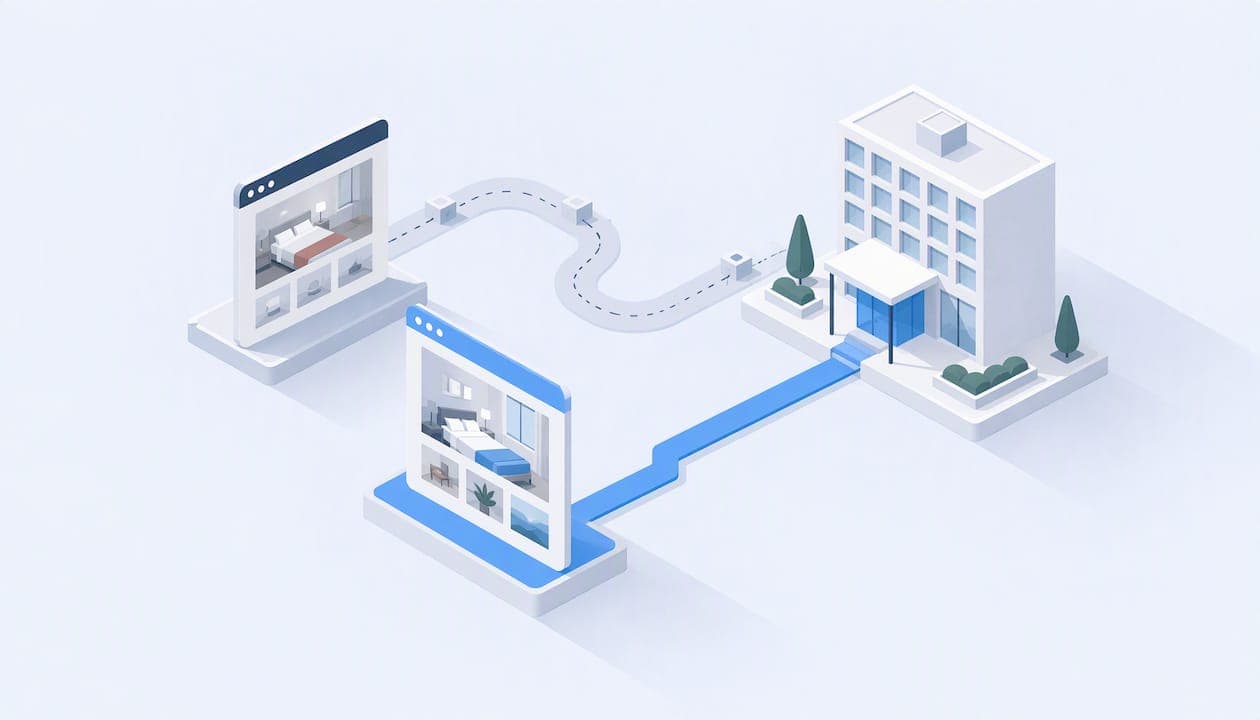
Independent hotel marketing comes down to one job: getting guests to find you, trust you and book with you directly, without a chain’s loyalty program or a shared marketing budget behind you. The hotels that do this well fix their online presence first, build a direct booking path second, and then feed it with social media, email and sales outreach. This guide walks through that order, what it costs to skip it, and how to tell whether it is working.
Free with every demo
Get a website guests and AI both recommend.
- See your new AI-visible website on the call
- Social content made and posted for you
- The website is yours to keep, free
TL;DR
- Acquisition costs are the real problem: U.S. hotels now spend roughly 15-25% of guest-paid revenue to win guests, up from 5-10% in the 1990s.
- Start with the free, high-leverage assets: a verified Google Business Profile, accurate OTA listings and a fast, mobile-friendly booking site.
- Use guest data and email to turn every stay into the start of the next booking.
- Group business is the most overlooked direct channel for independents, and it needs proactive outreach, not waiting.
- Measure bookings and revenue by channel, not traffic or followers.
What independent hotel marketing really means
A branded hotel borrows a lot: a reservation system, a loyalty program with millions of members, a brand.com that ranks well and a corporate marketing team. Chain affiliation also costs money, and as one independent operator put it in eHotelier, the incremental performance a brand delivers has to justify its incremental cost.
An independent owns none of that machinery, so it has to build its own. That means three things:
- Visibility: showing up in Google Search, Maps and hotel listings when someone searches your town or your type of stay.
- A direct booking path: a website and offers that make booking with you easier and better than booking through an intermediary.
- A relationship: guest data, reviews and communication that bring people back and send others your way.
Your advantage is also real. Guests choose independents for character, local knowledge and personal service. Marketing’s job is to make that visible at the moment someone is deciding.
Why the cost of acquiring guests matters
Before choosing tactics, look at what you pay today. An AHLA-commissioned study found that U.S. hotels’ customer-acquisition costs rose from 5-10% of guest-paid revenue in the 1990s to 15-25% in 2016. The same research found that brand.com bookings had higher net ADRs than any other channel in the study, meaning a direct booking tends to leave more money in your pocket per room night.
A later AHLA summary put the picture another way: hotels keep a revenue capture of 75-85% after paying all acquisition costs. Read that as a ceiling you can push on. Every booking you move from an intermediary to your own site raises it.
The same summary shows how the channels split. In 2017, almost half of U.S. bookings were made online, with over 22% of room nights booked through hotel websites, about 15% through OTAs and 10% through GDS. Those figures are dated, so treat them as proof that direct is a large channel, not as today’s exact split. Pull your own numbers from your PMS for the current picture.

A simple exercise: take last year’s room revenue by channel, multiply each channel by its true cost (commission, ad spend, staff time), and see what share of revenue you actually kept. That number is your baseline for everything below.
Fix your online presence first
Most independents lose bookings before a guest ever reaches their website. The cheapest wins are in places you already have.
Claim and complete your Google Business Profile
Google says a verified Business Profile lets owners control the information shown across Search and Maps, review traffic metrics and customer insights, gather and respond to reviews, and use Google Hotel Ads and Search Ads. Google also explains that hotel prices and booking links come from Hotel Ads and free booking links, and that you need a claimed and verified profile to edit all amenities from the dashboard.
In practice, check these first:
- Name, address and phone match your website exactly.
- Every amenity is ticked: parking, pet policy, breakfast, EV charging, accessibility.
- Photos are recent, bright and show rooms, common areas, the neighborhood and the real exterior.
- A free booking link points to your own booking engine, not just to intermediaries.
- Every review gets a reply, positive or negative.
Keep OTA listings accurate, not abandoned
You will probably stay on OTAs for reach, so the listing should work for you: same photos, same description, same policies, and a clear reason to book direct (a better rate, a perk, flexible terms) wherever the platform’s rules allow. A stale OTA page with old photos and a poor review response history quietly undermines everything else.
Build a website that closes
Guidance from NetSuite’s hotel booking guide lines up with what most hoteliers find: an SEO-friendly, fast and mobile-usable site, simple checkout, prominent direct offers and calls to action, strong photos or virtual tours, local-area information, live assistance and an incentive to join your email list.
A quick audit you can do in an hour on your phone:
- Can you get from the homepage to a priced room in three taps?
- Does the page load quickly on cellular data?
- Is the reason to book direct visible without scrolling?
- Do page titles and headings name your city and what makes you different?
- Is your rate on the site equal to or better than every other channel?
If any answer is no, fix that before you spend a dollar on advertising. Ads sent to a weak booking page just pay for abandoned carts.
Turn guests into a direct channel
The most valuable marketing asset an independent has is a list of people who have already stayed. A booking should begin the next marketing cycle, not end the current one.
With consented first-party data, even a small hotel can start simply. Revfine suggests segmenting by trip purpose, booking behavior, stay history and preferences, then tailoring repeat-stay offers, pre-arrival upsells, post-stay messages and seasonal promotions. You do not need advanced CRM software to begin. A spreadsheet with four segments and a consistent post-stay email will beat a sophisticated system nobody uses.
A workable starter sequence:
- Before arrival: a confirmation with directions, a local tip and an upsell such as a late checkout or a dinner reservation.
- During the stay: a prompt for questions and a quiet check that everything is right.
- After the stay: a thank-you, a review request and a direct-booking offer for a return visit.
- Seasonally: a short note to past guests ahead of your slow periods, with a reason to come back.
AHLA’s 2025 state of the industry report notes that using data and artificial intelligence can support more personalized guest experiences and cost-effectiveness, which can strengthen loyalty. For an independent, personalization is mostly a matter of remembering what a guest told you and acting on it.
Social media that builds a booking audience
Social media is often treated as a place to post room photos. That rarely moves bookings. Touchstay recommends content built around the property, the destination and what travelers need, rather than only room images or availability announcements.
For an independent, that translates into content you are uniquely placed to make:
- Short video of the neighborhood: the coffee shop you send guests to, the trail, the Saturday market.
- Staff stories, because guests choose independents partly for the people.
- Seasonal event roundups for your town, with a direct link to book a stay around them.
- Real guest moments, shared with permission.
- Quick answers to the questions guests ask in comments and messages.
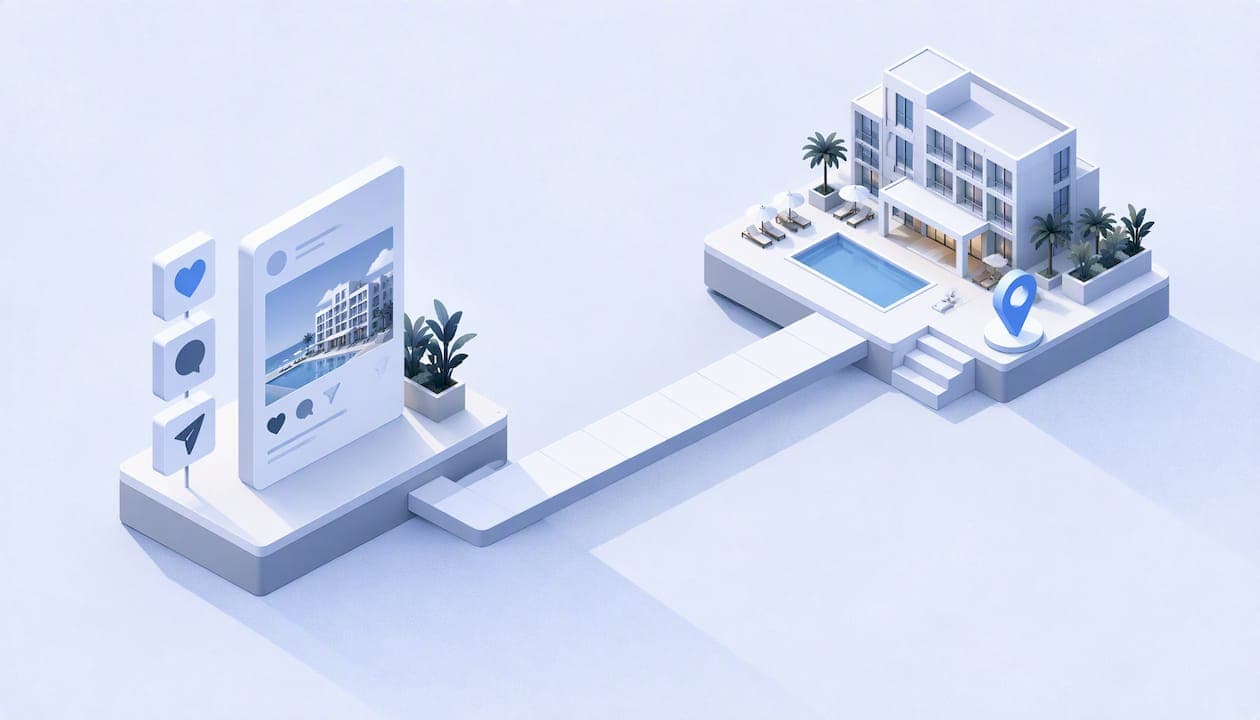
The point is not follower count. It is building an audience of people who might plausibly stay with you, then giving them a direct path from a post to a booking page. Pair posts with targeted ads aimed at the drive-in markets and travel segments that fit your property, and reply to every comment and message promptly.
Group bookings: the channel independents leave on the table
Transient leisure demand gets most of the attention, but group business such as weddings, sports teams, reunions, corporate retreats and small conferences can fill a block of rooms in a single conversation, often with no intermediary commission. The catch is that groups rarely find you by accident. Someone has to identify the planners, reach out, answer quickly and follow up.
Most independents have no one whose job that is. Owners and general managers are running the property. A realistic approach:
- List the organizations within a few hours’ drive that regularly gather people: companies, colleges, clubs, wedding venues, associations.
- Prepare a one-page group sheet with room counts, meeting or event space, rates and what is included.
- Contact planners directly, with a specific offer for their dates, not a generic brochure.
- Respond to every inquiry the same day and follow up three times before letting it go.
This is steady, unglamorous work, and it is the reason dedicated outbound sales support pays off for properties without a sales department.
Reviews are marketing
Reviews influence both Google visibility and the guest’s decision to book. Invite them after the stay, make it easy with a direct link, and reply professionally to all of them. For a critical review, acknowledge the issue, say what you changed and keep it short. Future guests read your replies as much as the reviews themselves.
Once you see patterns in the feedback, fix the operational cause. A recurring complaint about noise or breakfast is a product problem, and no amount of marketing will outrun it.
Do not treat OTAs as the enemy
Going direct does not mean abandoning every intermediary. Skift’s 2017 research stresses that distribution is nuanced and suggests a holistic approach to managing OTA and direct channels instead of a booking war. Kalibri Labs, cited in AHLA’s marketplace study, says hotels should manage a mix of channels to acquire business at the lowest cost possible, and that bookings made directly with the property are more profitable than those through an intermediary.
The practical stance: use OTAs for discovery and for filling gaps, and shift your marketing effort toward making repeat and referred guests book direct. Over time, the OTA share shrinks because your direct engine grows, not because you switched anything off overnight.
How to measure what is working
Traffic and followers are comfortable numbers and mostly useless on their own. Touchstay’s advice on search is to measure organic visits by enquiries or bookings rather than traffic alone, and the same logic applies to every channel.
Track monthly, by channel:
| Metric | What it tells you |
|---|---|
| Direct share of room nights | Whether your direct engine is growing |
| Net ADR by channel | What a booking is worth after costs |
| Cost of acquisition as % of revenue | Your position against the 15-25% industry range |
| Website booking conversion rate | Whether the site closes the visitors you earn |
| Repeat guest share | Whether data and email are working |
| Group inquiries and conversions | Whether outreach is producing real business |
| Review volume and average rating | Reputation momentum |
Give each change at least a full booking cycle before judging it, and change one major thing at a time so you know what caused the result.
Our perspective
We have spent over 20 years in hospitality, and the pattern we see in independent hotels is consistent: owners are asked to be revenue managers, social media editors, sales reps and reputation managers at once, on top of running a building full of guests. Something gives, and it is usually proactive selling and online presence.

So we do not think of independent hotel marketing as a menu of tactics. We think of it as a system with three working parts that have to run together: a sales effort that goes out and finds group business, social media that builds a guest audience and points it at a direct booking funnel, and an online presence that is accurate, reviewed and credible everywhere a guest looks. Remove one and the others leak. Great social posts that land on a stale Google profile waste money. A beautiful website with nobody chasing groups leaves rooms empty in the shoulder season.
We also believe speed matters. Hotels cannot wait six months for a strategy deck, which is why we commit to a 30-day deployment, and why our work is built specifically around independent hotels and not generic small-business marketing. The goal is simple: more commission-free bookings, and a hotel that depends less on any single intermediary.
— Chirag
Getting help without hiring a department
If you do not have the time or the team to run all of this, we built our Direct Booking System for exactly that situation. It combines a remote sales team for group bookings, social media management that grows your guest audience and direct booking funnels, and online presence repair covering your Google Business Profile, OTA listings and reviews.
We deploy within 30 days, and everything is aimed at one result: filling rooms with direct, commission-free bookings. See how the Direct Booking System fits your property.
FAQ
What is the best marketing strategy for an independent hotel?
There is no single tactic, but the order matters. Fix your Google Business Profile, listings and booking website first, then add email to past guests, social content built around your destination, and outbound sales for groups. That sequence turns the visibility you earn into direct bookings.
How much do hotels spend on marketing?
In the U.S., AHLA-commissioned research found hotels spend approximately 15-25% of guest-paid revenue acquiring customers, a figure that includes commissions as well as advertising. Your own number depends on your channel mix, so calculate it from last year’s revenue by channel.
How can an independent hotel increase direct bookings?
Make booking direct easy and rewarding: a fast mobile site, a simple checkout, a visible direct offer, a free Google booking link and an email list of past guests. Then give people reasons to arrive there, through local content, reviews and targeted social ads.
Should an independent hotel leave OTAs altogether?
Usually not. OTAs still bring discovery, and research suggests a mix of channels at the lowest overall cost is the sensible aim. Focus on growing direct share, especially from repeat guests and groups, so your reliance on any one intermediary falls over time.
Sources
- Chain vs Independent, from an independent operator’s view (eHotelier)
- Marketplace: Executive Summary (AHLA)
- Executive Summary, distribution study (AHLA)
- Google Business Profile overview
- Manage your hotel’s details (Google Business Profile Help)
- How to Increase Direct Hotel Bookings: 13 Strategies (NetSuite)
- What Is Hotel Marketing? (Revfine)
- State of the Industry (AHLA)
- Hospitality Marketing: 8 Strategies (Touchstay)
- 2017 Outlook on Hotel Direct Booking (Skift)