· 12 min read
Hotel LLM Optimization: How Independent Hotels Get Recommended by AI
Hotel LLM optimization explained for independent U.S. hotels: how ChatGPT and Perplexity find hotels, what to fix on your site and profiles, and how to measure it.
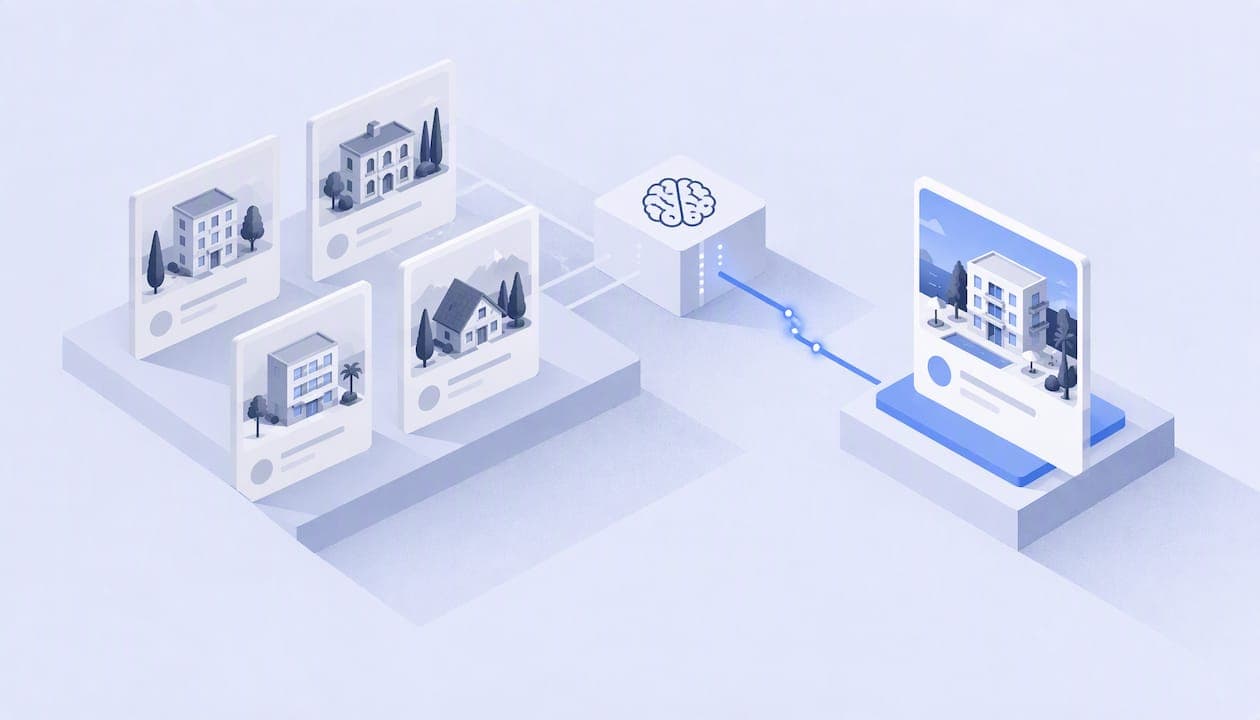
Hotel LLM optimization is the work of making your property easy for large language models, such as ChatGPT, Perplexity and Google’s AI features, to find, understand and recommend. For an independent hotel it comes down to four things: crawlable pages, clear and unique content, accurate profiles on the platforms AI tools read, and a booking path that sends the guest to you instead of to an OTA. There is no secret file or trick. It is good fundamentals, applied with AI retrieval in mind.
Free with every demo
Get a website guests and AI both recommend.
- See your new AI-visible website on the call
- Social content made and posted for you
- The website is yours to keep, free
Key Takeaways
- LLM optimization for hotels is mostly strong SEO fundamentals plus accurate, consistent information across your website, Google Business Profile, review sites and OTA listings.
- Google says no special AI-only markup or file is needed to appear in its AI features, so skip anyone selling you one.
- ChatGPT search can rewrite a guest’s question into several queries, so your pages need to answer specific questions: pets, parking, airport distance, family rooms, walkability.
- You can track ChatGPT referrals in analytics, because OpenAI tags that traffic with a utm_source of chatgpt.com.
- AI answers can be incomplete or outdated, so treat them as one more channel to monitor and not a guaranteed ranking.
What LLM optimization means for a hotel
A large language model generates answers from patterns in training data and, increasingly, from live web retrieval. When a traveler asks an assistant for a quiet boutique hotel near a ballpark with free parking, the tool does not show ten blue links. It builds one answer and cites a few sources.
Your job is to be one of those sources, or at least to be described correctly in the answer. That is the core of what marketers now call GEO (generative engine optimization), AEO (answer engine optimization) and LLMO (large language model optimization). The labels overlap. In practice they describe the same work: make your information retrievable, trustworthy and specific.
How it differs from classic SEO
SEO aims to rank a page for a keyword. LLM optimization aims to have your facts selected and repeated in a synthesized answer. Industry coverage notes that hotel marketers considering GEO are finding that LLMs lean toward authoritative publishers and trustworthy content rather than rewarding visibility, keywords and backlinks alone.
That shifts priorities in a few ways:
| Classic SEO | LLM optimization | |
|---|---|---|
| Goal | Rank a page for a query | Be cited or described accurately in an answer |
| Unit of work | Page and keyword | Fact, entity and question |
| What matters most | Links, relevance, technical health | Clarity, consistency across sources, trust |
| Success signal | Position and clicks | Mentions, citations, referral traffic, direct bookings |
The two are not rivals. Google’s own guidance says the foundation for appearing in its generative features is foundational SEO plus unique, people-first content. If your SEO is weak, your LLM visibility will be weak too.
How AI tools find and recommend hotels
Understanding the retrieval process tells you where to spend effort.
ChatGPT
OpenAI explains that ChatGPT search may rewrite a question into one or more targeted queries, run additional queries after reviewing the first results, and use general location derived from the user’s IP address to improve local relevance. A single hotel question can therefore turn into several searches: best hotels in a neighborhood, reviews for specific properties, availability, amenities.
Two practical consequences follow. First, a page that answers one narrow question clearly (for example, whether you allow dogs and what the fee is) can match one of those sub-queries. Second, local relevance matters, so your location details must be explicit and consistent.

OpenAI also states that ChatGPT ranks results using multiple factors meant to find relevant, reliable information, and that placement is not guaranteed. Nobody can promise you a spot, and you should be wary of anyone who does.
Perplexity
Perplexity describes its search product as drawing on a live web index and returning an answer with citations. Its developer documentation says search-enabled responses carry result batches with URLs, titles, snippets and dates, and the generated text includes citation markers mapped to those results. Clear titles, descriptive snippets and visible dates on your pages feed that structure directly.
Google’s AI features
Google’s guidance says to keep pages crawlable and eligible for Search, write unique and useful content with clear headings, and use Google Business Profiles and relevant feeds so local business details can appear. It also says hotels do not need special AI-only files or markup, including llms.txt, to show up in those features.
Step 1: Let the AI crawlers in
The cheapest fix is also the one most often missed. OpenAI uses OAI-SearchBot to surface websites in ChatGPT search. Its crawler documentation says that sites opted out of OAI-SearchBot will not be shown in ChatGPT search answers, though they can still appear as navigational links. OpenAI’s help center adds that a site should allow the bot to crawl it and permit OpenAI’s published crawler IP addresses.
What to check this week:
- Open your robots.txt file (yourhotel.com/robots.txt) and confirm nothing blocks OAI-SearchBot.
- Ask your web host or CDN whether bot protection or a firewall is blocking legitimate crawlers.
- Confirm your key pages are indexable in Google Search, since that is the base for Google’s AI features.
- Make sure rates, rooms and policies sit in plain text on the page, not only inside images, PDFs or a booking widget that does not render for crawlers.
Blocking training crawlers is a separate decision from blocking search crawlers. Decide each one on purpose and have whoever manages your site document it.
Step 2: Write content that answers real guest questions
Because an assistant breaks a request into sub-queries, your site should contain a clear, findable answer to every question a guest asks before booking. Think of each one as a possible retrieval target.
Strong candidates for an independent hotel:
- Room details: bed types, square footage, accessible rooms, connecting rooms, views.
- Arrival logistics: distance to the airport, parking cost, shuttle, check-in and check-out times.
- Policies: pets, cancellation, deposits, resort or destination fees.
- Neighborhood: what is within a ten-minute walk, nearby venues, hospitals, universities, convention centers.
- Who it suits: families, business travelers, wedding guests, sports teams, small groups.
- What makes you different: history, owner story, renovations, local partnerships.
Follow Google’s guidance on structure: clear organization with headings and sections, plus relevant images and video. Use one page per topic, a descriptive H1, and short factual paragraphs. Put the answer in the first sentence under the heading. A model scanning for a snippet should not need to dig.
Be specific, not generic
A sentence like “close to everything” tells a model nothing. “A seven-minute walk to the convention center and 18 minutes by car to the airport” can be retrieved, quoted and checked. Replace adjectives with facts you can verify, and keep them current.
Step 3: Fix your presence beyond your own website
AI tools fuse information from several places, so a perfect website with a neglected Google Business Profile still produces muddled answers. Research into ChatGPT’s hotel behavior, published on a personal research blog, describes results being combined from multiple sources including web search, places data and reviews. Treat that as an indication and not an official specification, but the practical lesson is sound: consistency across sources wins.
Audit these places for the same name, address, phone number, amenities, photos and policies:
- Google Business Profile, including categories, attributes, hours, photos and the booking link.
- Your OTA listings, which often rank for your own name and are read by AI tools.
- Review sites, where the recurring themes in guest reviews often become the way an assistant describes you.
- Local tourism board and chamber of commerce listings.
- Social profiles, which should link back to your direct booking page.
Reviews deserve special attention. If guests repeatedly mention thin walls or a slow elevator, an AI summary will likely repeat it. Respond to reviews, fix what is fixable, and encourage satisfied guests to describe specifics: the breakfast, the staff member who helped, the quiet courtyard.
Structured data
Google documents that LocalBusiness structured data can give it business hours, departments and reviews, and that the Maps Booking API can enable bookings and other actions in Search. Google does not guarantee that rich results will display. Add accurate schema where it fits your property and keep it matching the visible page, but do not expect markup alone to change your visibility. Google also says no AI-specific markup is required.
Step 4: Make sure the click ends in a direct booking
Visibility has no value if the guest lands on a page that cannot convert. When an AI answer cites your site, that guest arrives with a specific question and a plan. The page they land on should show rates, availability and a booking path without friction, on mobile first.
That is where the OTA question comes back. If the assistant surfaces an OTA listing for your hotel because your own site is thin, the commission goes to the OTA. If it surfaces your site and your booking engine works, the booking is yours. Strengthening your site, profiles and booking flow is the same work that reduces OTA dependence.
A short checklist for the landing experience:
- The booking button is visible without scrolling on a phone.
- Rates and taxes are shown clearly before checkout.
- Cancellation terms sit next to the price.
- Group and event inquiries have their own simple form, since groups are often won by a human reply and not a checkout page.
Step 5: Measure what AI search sends you
You cannot manage what you do not track. OpenAI says it automatically appends utm_source=chatgpt.com to referral URLs for traffic from ChatGPT search results, so you can see it in your analytics platform.
A simple monthly routine:
- In your analytics, filter sessions by source chatgpt.com and note sessions, engagement and booking-engine clicks.
- Review other referral sources that look like AI assistants and answer engines.
- Run a fixed set of 10 to 15 prompts in the major assistants, such as “best boutique hotel in [your city] for a weekend” or “pet-friendly hotel near [landmark]”. Record whether you appear, how you are described and which sources are cited.
- Compare direct bookings and direct-channel share month over month.
Keep your expectations realistic. AI referral volume is still small for most properties, and attribution is imperfect because some users read an answer and then search your name directly. Look at branded search and direct traffic alongside the tagged referrals.
Limits and risks to plan for
OpenAI warns that ChatGPT search answers and citations can be incomplete, outdated or incorrect. Expect occasional wrong rates, closed amenities or confused locations. When you find an error, trace it to its source, which is often an old listing, and correct it there.
There is also an adoption gap. A 2026 industry report summarized by trade media found that nearly 80% of major hotel chains use AI in some capacity, compared with 41% of independent hotels. The same coverage reports that U.S. travelers’ use of generative AI for trip planning more than doubled in a year and warns that independents risk becoming less visible unless their information is structured so systems can recognize and surface it. Chains have teams for this. Independents can close the gap by being more precise and more consistent, which does not require a large budget.
Finally, the landscape moves quickly. Treat any claim of a guaranteed AI ranking as a red flag, and revisit your approach a few times a year as the tools change.
Our perspective: AI visibility is a direct booking problem
We have spent more than 20 years in hospitality marketing, and the pattern we see in AI search is familiar. The hotels that win are not the ones with the cleverest tactic. They are the ones whose basics are in order and whose story is easy to repeat.
Most independents we talk to are not losing AI visibility because of a missing technical trick. They are losing it because their Google Business Profile is half finished, their OTA listing says something different from their website, and their reviews have gone unanswered for a year. Those same gaps are what push guests toward OTAs and the commission that comes with them.
So we do not treat GEO and AEO as a separate project. We treat them as part of one question: when a guest is deciding where to stay, does every place they might look tell the same accurate, appealing story, and does it lead to your own booking page? Fix the online presence, build an audience through social media, and have people actively sell to groups. Then AI tools have good material to work with, and the guest has a reason to book direct.
— Chirag
How HotelHero can help
If you would rather not audit crawler access, listings, reviews and booking flow yourself, that is the work we do for independent hotels. Our Direct Booking System combines online presence repair (Google Business Profile optimization, OTA listings management and reputation review services), targeted social media management and a remote sales team focused on group bookings. We also offer GEO and AEO services, and we stand behind a 30-day deployment guarantee.

See how the pieces fit on our Direct Booking System page, look at online presence repair if your listings and reviews need attention first, or contact our team to talk through your property.
A 30-day starting plan
You can begin without any outside help. Here is a sequence that fits a small team.
Week 1: Access and accuracy. Check robots.txt and firewall rules for OAI-SearchBot. List every place your hotel appears online and note every inconsistency in name, address, hours, amenities and policies.
Week 2: Profiles. Complete your Google Business Profile, correct OTA listings, and respond to the last 20 reviews you have not answered.
Week 3: Content. Write or rewrite the pages that answer guest questions: rooms, parking, pets, neighborhood, groups. Lead each section with the direct answer and use facts, not adjectives.
Week 4: Measurement and booking path. Set up a report for chatgpt.com referrals, run your baseline prompts in the main assistants, and walk through your own booking flow on a phone, fixing anything that makes a direct booking harder than an OTA booking.
Repeat the prompt test monthly. Small, steady improvements in clarity and consistency compound, and they help every channel at once, not only AI.
FAQ
Is hotel LLM optimization different from GEO and AEO?
The terms overlap heavily. LLM optimization, GEO and AEO all describe making your content retrievable and trustworthy for AI-generated answers. For a hotel, the actions are the same: crawlable pages, clear answers, consistent listings and a working direct booking path.
Do I need an llms.txt file or special schema for AI visibility?
Not for Google. Its guidance says hotels do not need special AI-only files or markup, including llms.txt, to appear in its AI features. Standard structured data such as LocalBusiness can still help Google understand your property, though display is not guaranteed.
Can I pay to be recommended by ChatGPT?
No ranking is guaranteed. OpenAI says it ranks results using multiple factors aimed at relevant and reliable information, and that placement is not assured. What you can control is access for its crawler, the quality of your content and the consistency of your listings.
How do I know if AI search is sending me guests?
Check your analytics for sessions with the source chatgpt.com, which OpenAI adds to referral links from ChatGPT search. Pair that with monthly prompt tests and a look at branded search and direct traffic, since some guests read an answer and then search your name.
Will AI search replace OTAs for hotel discovery?
Nobody can say yet. What is clear is that AI tools pull from many sources, including OTA listings, so a thin direct site leaves the story to others. Strong direct content and profiles give you the best chance to turn AI discovery into commission-free bookings.
Sources
- From SEO to GEO, hotels confront the future of digital marketing (PhocusWire)
- Searching the web with ChatGPT (OpenAI Help Center)
- Overview of OpenAI Crawlers (OpenAI)
- Publishers and Developers FAQ (OpenAI Help Center)
- Perplexity Search
- Streaming Citation Parsing (Perplexity docs)
- Google’s Guide to Optimizing for Generative AI Features on Search
- Local Business structured data (Google Search Central)
- Cloudbeds flags six trends for independent hotels in 2026
- Inside ChatGPT’s Hotel Search Engine