· 11 min read
Hotel Local SEO: How Independent Hotels Win Nearby Searches
Hotel local SEO explained in plain words: fix your Google Business Profile, keep listings consistent, earn reviews and turn map searches into direct bookings.
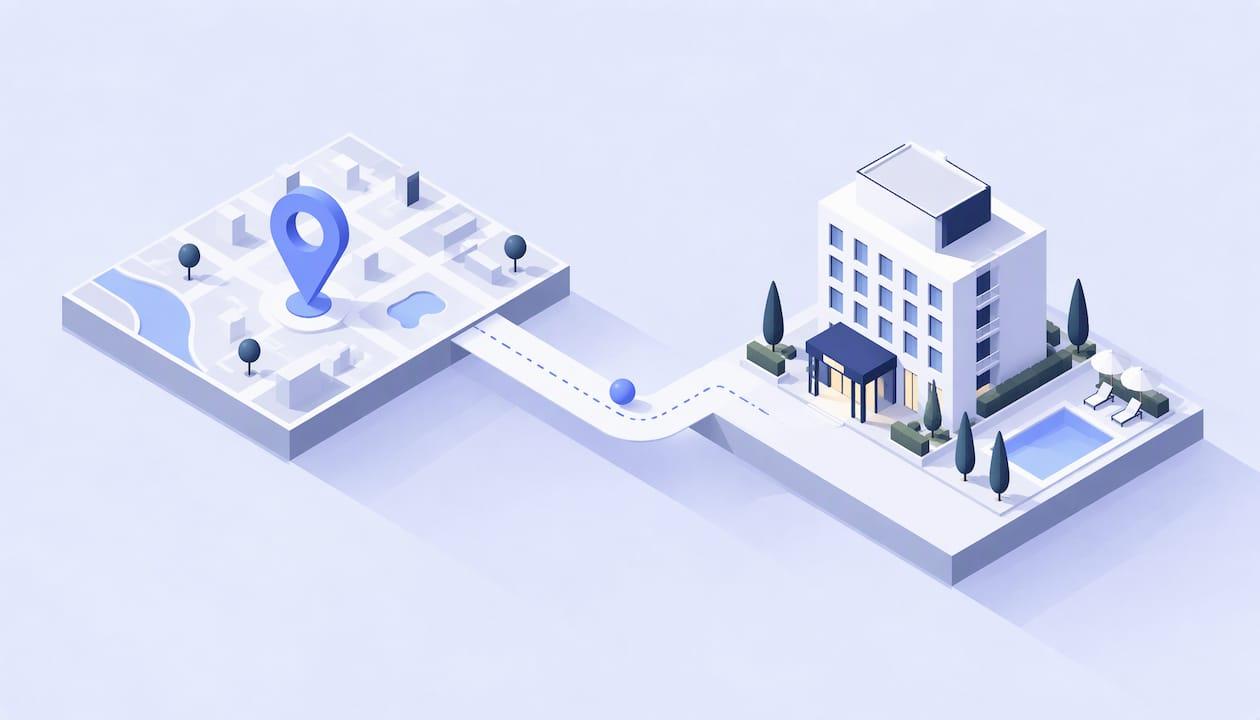
Hotel local SEO is the work that makes your hotel show up when a traveler searches for a place to stay in your area, on Google Search and Google Maps. For an independent hotel, it comes down to three things: a complete Google Business Profile, listings that match everywhere, and a website and reviews that give travelers a reason to book with you. When those line up, more guests book direct and fewer pay an OTA commission. We built our Online Presence Repair service around exactly this work, so a hotel owner does not have to do it between check-ins.
Free with every demo
Get a website guests and AI both recommend.
- See your new AI-visible website on the call
- Social content made and posted for you
- The website is yours to keep, free
Key Takeaways
- Google ranks hotel results on relevance, distance and prominence. You cannot pay for a better organic spot, but you can improve each of those three.
- Your Google Business Profile is the base. Fill it out fully, pick the right categories and keep the details accurate.
- Reviews, consistent listings and a clear website all support each other. A weak link in one hurts the rest.
- Measure bookings, calls and website clicks, not just rankings.
- Local search now feeds AI answer tools too, so clean, consistent facts about your hotel matter more each year.
What hotel local SEO actually is
SEO stands for search engine optimization. It means making your online presence easy for Google to understand and trust. Local SEO focuses on searches tied to a place: “hotel near the convention center,” “pet friendly hotel in Asheville,” or just “hotels near me.”
These searches matter for independent hotels because you have one location. Ranking nationally for “hotel” does little for you. Ranking first for travelers who are already looking at your town, your neighborhood or your nearest landmark is what fills rooms.
Local results usually show up in two places. One is the map area at the top of the page, with a few hotels pinned on a map. The other is the regular list of websites below it. A strong hotel can appear in both.

How Google decides who ranks
Google’s own help pages for hotel owners say that hotel search ranking is based on relevance, distance and prominence. Here is what each one means for you:
- Relevance: How well your hotel matches what the person typed. A profile and website that clearly say “boutique hotel, downtown, pet friendly, free parking” match more searches than vague copy.
- Distance: How close your hotel is to the place the person searched for, or to where they are. You cannot move your building, but you can make sure Google has your exact address and location.
- Prominence: How well known and trusted you look. Reviews, ratings, mentions and a solid website all add to this.
Google also states that hotels cannot buy or request a better organic ranking. Accurate hotel information and good reviews are what help. That is good news for an independent. A big brand cannot simply outspend you on organic results.
Start with your Google Business Profile
Your Google Business Profile (GBP) is the free listing that appears in Search and Maps with your photos, reviews, website link and contact details. It is the most important piece of hotel local SEO.
Google’s 2026 hotel playbook says a complete and up-to-date profile is key to visibility, trust and engagement. The same playbook reports that Free Booking Links bring 12 or more extra bookings per month per hotel, and that hotels with over 100 organic clicks a month see 30% more direct bookings from them. Those are Google’s figures for its own program, so your results will depend on your traffic.
A simple profile checklist
- Claim the one profile for your location. Google’s business guidelines allow only one profile per location. Duplicates confuse Google and split your reviews.
- Use your real name. The name should match your signage, stationery and branding. Do not stuff in extra keywords like “Best Cheap Hotel Downtown.”
- Use an exact street address. Google says the address must be accurate and precise.
- Pick categories carefully. Google tells businesses to use as few categories as possible and to choose ones that finish the sentence “This business IS a…” For a hotel, that means “Hotel” is your main category, not a list of things you have.
- Skip business hours. Google’s guidelines say indoor lodging businesses such as hotels and motels should not list hours of operation.
- Add your website and booking link. This is where direct bookings start. Point the link to your own booking page, not a general page that makes guests hunt.
- Fill in amenities and attributes. Pet friendly, free breakfast, EV charging, pool. Travelers filter on these.
- Upload fresh photos. Rooms, lobby, exterior, breakfast, the view, the street out front.
- Post updates. Local events, seasonal offers and new features keep the profile active.
This list is simple, but it is not quick. Each item needs to be checked again every few months, because amenities change, photos age and new fields appear. This is the part of our Online Presence Repair service that covers Google Business Profile optimization, so your profile stays complete without a staff member babysitting it.
Keep your hotel’s details the same everywhere
Your hotel appears on many sites: Google, Bing, Apple Maps, Tripadvisor, Yelp, OTAs, local tourism boards and the chamber of commerce. These listings are often called citations. Each one should show the same name, address and phone number (people call this NAP) and the same website.
Why it matters: when the details disagree, Google has to guess which is right. And travelers get confused. A phone number that rings a closed line or an old address that sends a guest to the wrong block costs you a booking and a review.
Hotel News Resource makes a related point in a November 2026 piece on balancing OTAs and direct demand: hotel information needs to be consistent and clearly available online, alongside website content, reviews and reputation work. Shifting guests off OTAs takes more than hoping they find you.
Where inconsistencies hide
- An old name from before a rebrand or ownership change
- A second phone number from a former front desk system
- Different suite or building details between listings
- Outdated amenity lists on OTA pages
- A website link that points to a retired domain
OTA listings deserve special care. They are often the first thing a traveler sees, and they carry your photos and description. Managing OTA listings so they stay accurate and send guests toward your direct booking page is part of our Online Presence Repair work.
Reviews: the prominence engine
Reviews do two jobs. They help you rank, because Google treats them as a sign of trust. And they help travelers decide, because people read them before they book.
Google’s hotel guidance says accurate information and reviews can improve how your property reaches travelers. So build a steady review habit:
- Ask at the right moment. Right after a good stay, by email or text, with a direct link to your Google review page.
- Reply to every review. Thank the happy guests by name when you can. Answer the unhappy ones calmly and offer to fix the issue offline.
- Look for patterns. If five guests mention a slow elevator or great breakfast, that is content for your site and your profile.
- Keep a steady pace. A few new reviews every week looks healthier than fifty in one month and none for a year.
If your team has no time for this, our reputation review services handle it as part of the same package.
Your website: where local search turns into bookings
Google brings the traveler to you. Your website has to close the sale. Three things matter most.
Pages that match local searches
BrightLocal-style advice and Google’s own relevance factor point the same way: write pages for the searches your guests really type. Think “hotel near [your landmark],” “hotel in [neighborhood],” or “hotel with [feature].” One good page per real search idea beats a long page that tries to cover everything.
Focused phrases also work better than broad ones. “Couple-friendly boutique hotel near the river walk” is a better target than “best hotel in town.” Fewer people search it, but those who do are much closer to booking.
Good local page ideas:
- Your neighborhood and what is within a five-minute walk
- The big local draws: a stadium, hospital, university, trail or festival
- Group and crew stays, if you want that business
- A plain explanation of parking, pets and check-in
A fast, mobile-friendly booking path
Most local searches happen on a phone. If your page loads slowly, or the booking button is hard to find, the guest goes back to the OTA. Test your own site on your own phone. Count the taps from the home page to a price. Fewer is better.
A reason to book direct
Give the guest something clear: a lower rate, free parking, a late checkout or a free breakfast. Say it on the page near the booking button. We cover this in more detail in our guide to increasing hotel bookings and our independent hotel marketing playbook.
If you want to see how local visibility connects to the rest of your direct booking plan, this direct booking strategy walks through the first 30 to 90 days of keeping guests coming back to book on your own site.
Don’t fight the OTAs. Rebalance.
Local SEO is not about cutting OTAs to zero. Hotel News Resource notes that OTAs give independent properties real visibility, and that the right mix depends on property size, market, traveler mix and your marketing resources, not on a fixed percentage. A research report from Skift also treats hotel distribution as a mix of channels, weighing both OTA discovery and the value of moving bookings direct.
The goal is simple: keep the OTA reach you need, and let local search bring in the guests who would otherwise pay a commission to find you. Our hotel channel management guide shows how to set that balance.
Local SEO and AI answers
Travelers now ask AI tools questions like “where should I stay near the hospital in Fort Wayne?” These tools pull from the same kinds of facts that local SEO builds: your profile, your reviews, your website and your listings. If those facts are clear and match each other, you are easier to recommend.
This is what people call Generative Engine Optimization (GEO) or AI Engine Optimization (AEO). It is local SEO’s next step, not a separate job. Our AI visibility services are built for hotels that want to show up in those answers.
How to measure whether it works
Rankings alone can fool you. A better view looks at four layers:
| Layer | What to watch | Where to find it |
|---|---|---|
| Visibility | Map and search impressions | Google Business Profile, Search Console |
| Engagement | Website clicks, calls, direction requests | Google Business Profile |
| Conversion | Direct bookings, booking page visits | Your booking engine, website analytics |
| Reputation | Review count, rating, response rate | Google and other review sites |
Take a snapshot first. Write down your numbers for 30 days, or 60 to 90 if you can, before you change anything. Then check weekly for quick signals, monthly for trends and quarterly for the big picture.
A rise in impressions only counts if it leads to clicks, calls and bookings. Tag your booking links so your analytics show which ones come from Google. Then compare direct bookings month to month, and note the cost you saved in commissions.
Our perspective
Most independent hotels we talk to know they should “do SEO.” What stops them is time. The owner is also the night auditor, the repair crew and the revenue manager. A profile gets claimed once and then goes stale.
We think local search works best when it is part of one direct booking system, not a side project. Your profile, your listings, your reviews, your social posts and your website should all tell the same story, and each should point the guest toward your own booking page.
That is why we combine online presence repair, social media and a remote sales team for group bookings. Our approach is built for independent hotels, with a focus on commission-free bookings and a 30-day deployment guarantee. The point is simple: fewer commissions, more guests who chose you.
Chirag
What a done-for-you approach looks like
If you would rather hand this work off, HotelHero’s Online Presence Repair covers Google Business Profile optimization, OTA listings management and reputation review services. Pair it with social media management to build a local audience that follows you and books direct. When you are ready, contact our team and tell us about your property.
A simple 90-day plan
Days 1 to 30: Fix the base. Claim and complete your profile. Remove duplicates. Check every listing for name, address, phone and website. Record your baseline numbers.
Days 31 to 60: Build trust. Start asking every guest for a review. Reply to old and new reviews. Add fresh photos and your amenities. Write or improve two local pages on your site.
Days 61 to 90: Push bookings. Add a clear direct booking offer to your site and profile. Post about local events. Compare your numbers with your baseline and decide what to repeat.

FAQ
What is hotel local SEO?
It is the work of getting your hotel to appear when people search for places to stay in your area. It centers on your Google Business Profile, your listings, your reviews and your website. The goal is more calls, clicks and direct bookings.
How long does hotel local SEO take to work?
Some fixes, like correcting a wrong phone number, help quickly. Rankings and review growth build over months. That is why a 30-day baseline and a 90-day plan work well: you see the trend, not just one week.
Do I still need OTAs if my local SEO is strong?
Many independent hotels keep OTAs for reach and use local SEO to win the guests who would book direct. The right mix depends on your market, your size and your guests. The aim is to lower how much you pay in commissions, not to disappear from OTAs.
Which Google Business Profile details matter most for a hotel?
Start with an accurate name, exact address, the right primary category, your website and booking link, amenities and photos. Do not list business hours, since Google’s guidelines say hotels should leave them out. Keep everything current as things change.
Does hotel local SEO help with AI search tools?
Yes, in a practical way. AI tools rely on clear, consistent facts about your hotel, and local SEO builds exactly that. Complete profiles, matching listings and strong reviews make your hotel easier to name in an answer.
Sources
- Frequently asked questions for hotel owners, Google Hotel Center Help
- Hotels GBP Best Practices Playbook 2026, Google
- Guidelines for representing your business on Google
- Finding the Right Balance Between OTAs and Direct Demand, Hotel News Resource
- 2017 Outlook on Hotel Direct Booking, Skift Research