· 12 min read
Hotel Paid Advertising: How to Get Direct Bookings
A plain guide to hotel paid advertising: Google Hotel Ads, Performance Max, bidding, tracking, and how to turn paid clicks into commission-free direct stays.

Hotel paid advertising means paying to show your hotel to travelers who are searching for a place to stay, and sending them to your own booking page instead of an online travel agency (OTA). The main U.S. options are Google hotel campaigns, Performance Max for travel, and paid search. They work best when the page the click lands on is ready to turn a visitor into a guest. That is why we pair paid traffic with a direct booking system, a strong Google Business Profile, steady social content, and a remote sales team for group stays.
This guide explains each channel in plain words. It shows what a hotel needs to start, how bidding works, how to track results, and where the rest of your direct booking plan fits in.
Free with every demo
Get a website guests and AI both recommend.
- See your new AI-visible website on the call
- Social content made and posted for you
- The website is yours to keep, free
Key Takeaways
- Google hotel campaigns show your rates, photos, and a booking link when travelers search for a hotel on Search or Maps.
- To run them, you need a hotel list, live prices, and landing pages set up in Google’s Hotel Center and linked to Google Ads.
- Pick a bidding method you can measure. Smart Bidding needs conversion tracking, so set that up first.
- Compare the cost of each paid booking with what an OTA booking costs you, using your own booking engine and property management system (PMS) data.
- Paid ads rent attention. A direct booking site, a good Google profile, social content, and group sales build attention you keep.
What Hotel Paid Advertising Includes
Paid advertising is any channel where you pay for the chance to be seen. For a hotel, the common ones are:
- Google hotel campaigns. Ads that show prices and a booking link when someone searches for a hotel.
- Performance Max for travel. A Google campaign type that runs across many places at once.
- Paid search. Text ads that show when someone types a phrase like “hotel near the stadium.”
- Paid social. Ads on social platforms aimed at people by place and interest.
- Remarketing. Ads shown to people who visited your site but did not book. We cover that in our guide to hotel remarketing.
The goal is the same in each case: get a traveler who is ready to book onto your own website. A booking made there carries no OTA commission.
Most hotels do not need all of these at once. A small independent hotel often starts with Google hotel campaigns, since the traveler is already searching for a room, and adds the others as the base grows.
Google Hotel Ads: The Core Channel
Google Hotel Ads (also called hotel campaigns) are the ads travelers see when they search for a hotel on Google. Google’s guide for hotels says that after a traveler searches on Search, Maps, or the Assistant, they can see a hotel module with photos, names, prices, and a map. Picking a hotel shows up-to-date prices and booking links for the chosen dates and guests.
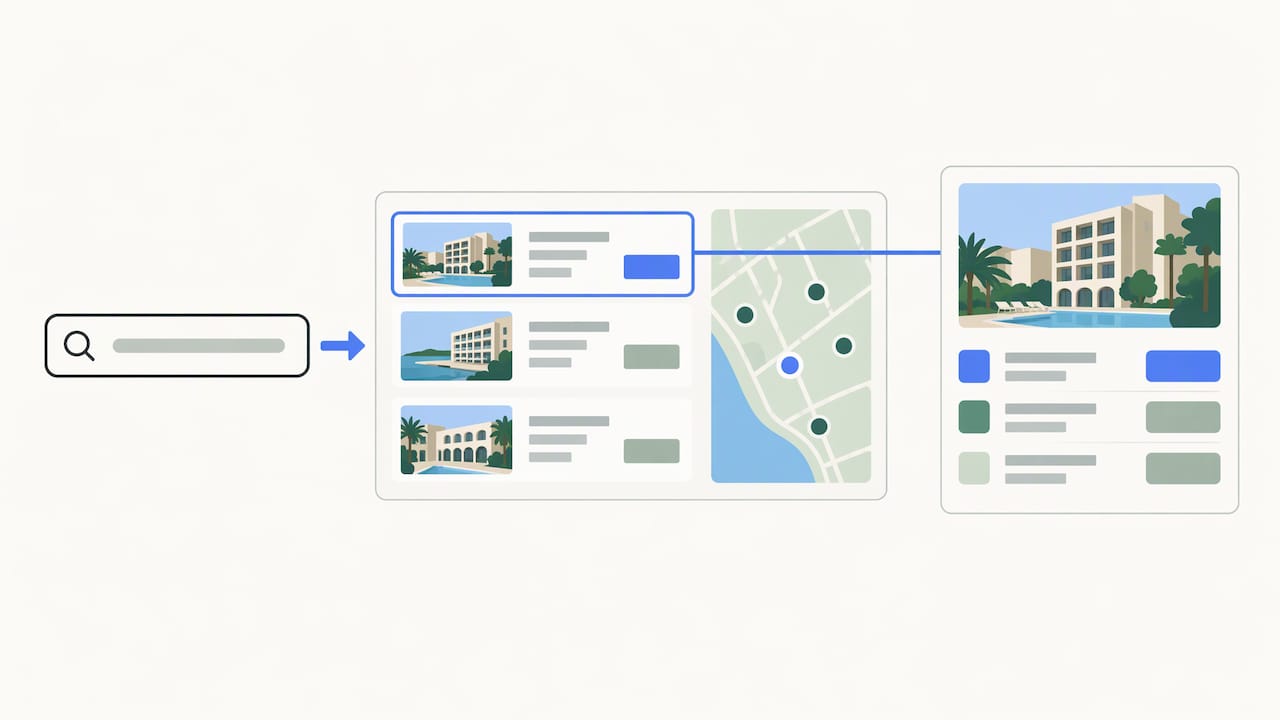
Google’s Hotel Center help page adds that these ads can show amenities too, and that you can aim your budget at travelers based on their country and device.
This matters because the traveler sees your price next to your photos at the moment they choose. If your direct rate is good, the booking link sends them to you.
What You Need to Get Started
You cannot just turn these ads on. Google Ads Help says hotel campaigns need a hotel list, current prices, and website landing pages. All of it is managed in Hotel Center and linked to your Google Ads account.
In plain terms, you need three files:
- A hotel listing feed. The basic facts about your property.
- A price and availability feed. Your real rates and open rooms for each date.
- A landing-page file. The pages where travelers finish the booking.
Google’s guidebook strongly recommends an integration partner for this. Doing it directly takes technical staff to maintain the feeds, a 24x7 API (a live data connection), and high price accuracy. Most independent hotels do not have that staff, so a booking system that connects to Google is the practical route.
Free Booking Links
There is also a no-cost option. Google explains that a property with a bid in a hotel campaign, available rates, and a landing page is automatically eligible for free booking links, with no cost per click. Ranking depends on traveler preference, value, landing-page experience, and price-accuracy history. Nobody can pay for a higher spot there.
The lesson: a clean, accurate listing and a fast booking page help you on both the paid and free sides.
Performance Max for Travel
Performance Max is a campaign type that uses Google’s automation to show your ads in many places. Google’s help page on travel goals says Performance Max for travel is built to drive more direct hotel bookings. It can appear across YouTube, Display, Search, Discover, Gmail, Maps, and the Travel channel, and it can target your property terms on Search.
That reach is useful for a hotel that wants to be seen early, when a traveler is still deciding where to go. It also means your photos and text need to be strong, since the system picks where to show them.
Paid Search and Paid Social
Paid search puts a text ad above or near the regular results. It suits phrases that signal a plan to travel, such as your city plus “hotel,” or a local event plus “where to stay.” Keep the ad tied to a landing page that matches the promise. If the ad says “free parking,” the page should say it in the first screen.
Paid social works earlier in the trip. People scroll, see a photo of your rooftop or a weekend deal, and save it for later. These ads pair well with an active page, because a curious traveler often checks your profile before booking. Our guide to hotel social media marketing shows how to build that audience, and our social media management service keeps it running.
How to Set a Budget and Choose a Bidding Method
A bid is the amount you agree to pay for a result. Google’s bidding best practices list these options for hotel campaigns:
| Bidding method | What you pay for |
|---|---|
| Commission (per conversion) | A share of the booking when a guest books |
| Commission (per stay) | A share after the stay, for select partners only |
| Target ROAS | Google adjusts bids to hit a return on ad spend goal |
| Max CPC | A top amount per click, fixed or as a percent |
| Enhanced CPC | Google tweaks your manual bids when a click looks likely to book |
ROAS means return on ad spend: the revenue you earn for each dollar spent. CPC means cost per click.
Same page, one key rule: all Smart Bidding strategies need hotel-campaign conversion tracking. For Enhanced CPC and Target ROAS, the conversion category must be set to “Purchase.” If tracking is not working, automated bidding has nothing to learn from.
Setting the Budget
Google lets you set campaign budgets, target by country and device, adjust bids by itinerary, and set bids by hotel group. Use those controls like this:
- Start with a number you can lose. Pick a monthly amount that will not hurt cash flow if the first month teaches you more than it earns.
- Spend where you have empty rooms. Midweek and shoulder-season dates are better targets than a weekend you will sell out anyway.
- Bid more on high-value stays. Longer stays and higher room rates earn more per click, so they can support a higher bid.
- Review monthly. Move budget toward the dates and traveler groups that book.
A worked example with made-up numbers: a hotel spends $1,000 on ads in a month and earns $6,000 in direct room revenue from those ads. The return is 6 to 1. If the same $6,000 had come through an OTA charging 15%, the fee would have been $900. In that case the ads cost slightly more than the OTA fee, but the guest now has your email and a reason to come back. Your own numbers will differ, so use your own data.
Aim the Ads at the Right Travelers
Targeting means choosing who sees your ad. Google’s hotel guidebook says hotel ad targeting uses signals such as the traveler’s location, device, time of day, and audience lists. It also uses inputs unique to hotels, like the property chosen and the date range. Campaigns can be tailored by availability and by traveler itinerary.
In Google’s Hotel Center help, ad groups let you adjust bids by the traveler’s itinerary, and hotel groups let you set base bids by property traits.
Simple ways to use this:
- Bid higher on mobile if most of your last-minute bookings come from phones.
- Bid higher for travelers searching far ahead if you want to fill a slow season early.
- Use audience lists to bring back people who already visited your site.
Make the Click Count: The Booking Page
An ad gets the visit. The page gets the booking. Paid clicks cost money each time, so a weak page wastes them.
Check these on your landing page:
- Speed on a phone. Many travelers search on mobile.
- The rate they saw. The price on the page must match the price in the ad. Google tracks price accuracy, and it affects how you rank on the free side too.
- A clear booking button that is visible without scrolling.
- Photos and room details that match what the ad promised.
- Direct-only perks, such as a late checkout or a free breakfast. Our guide to hotel booking promotions has ideas that give travelers a reason to book with you.
We cover the page itself in our guide to a direct booking website. A hotel that fixes the page before raising the ad budget usually gets more from every dollar.
How to Measure Results
You cannot manage what you do not count. Track these:
- Revenue from paid ads
- Ad spend
- Cost per booking
- Conversion rate (the share of visitors who book)
- The split between direct and OTA bookings
- Assisted conversions, meaning ads that helped a guest book later through another path
One revenue manager’s guide to metasearch return suggests matching booking engine and PMS data against ad platform data. It also suggests comparing net ROAS with what OTA distribution costs you, and running controlled bid tests to see what the ads add. Treat it as a method to try on your own numbers.
The habit of asking which lead source turned into a booking is useful in any hospitality business. For another view of that habit, see these catering lead sources that convert into bookings.
A simple monthly routine:
- Pull direct bookings from your booking engine.
- Pull ad conversions from Google Ads.
- Match them by date and booking value. Note any gaps.
- Compare the cost of each paid booking with your OTA cost for the same dates.
- Shift budget to what worked.
Paid Ads Are One Part of a Direct Booking Plan
Paid ads send traffic as long as you pay. The rest of your plan builds traffic you keep. Here is how the pieces fit:
| Piece | What it does for direct bookings |
|---|---|
| Google Business Profile | Shows your hotel, photos, and reviews to people searching nearby. See our setup guide. |
| Local search | Helps you show up for nearby searches. See hotel local SEO. |
| Content and social | Builds an audience that knows you before they search. See hotel content marketing. |
| AI visibility | Helps AI tools describe and recommend your hotel. See hotel ChatGPT visibility and AI recommendation optimization. |
| Group sales | Fills blocks of rooms through direct outreach. |
| Remarketing | Brings back visitors who did not book. |
When these work together, each paid click lands on a hotel that already looks trustworthy. Reviews, photos, and a profile that matches your site raise the odds that a visitor books.
In-House or Outside Help?
Some hotels run ads themselves. Others hand the work to people who do it daily. Ask these questions before you decide:
- Who will own it every week? Bids, budgets, and feeds need steady attention.
- Can your booking system send live rates to Google? Google warns that direct integration takes technical staff and accurate prices.
- Is conversion tracking working? Without it, automated bidding cannot learn.
- Do you have time for the rest? Profile updates, reviews, social posts, and group sales all affect how well ads convert.
Most independent hotels run lean. Owners and managers already handle guests, staff, and repairs. A team that knows hotels can take on the marketing and sales work so you can focus on running the property.
Perspective
Independent hotels do not lose bookings because they lack ads. They lose them because travelers meet the OTA first, and the hotel’s own pages, profile, and social accounts give no reason to switch.
Our view is that a hotel should build its direct booking base first, then add paid ads on top. We built our Direct Booking System around that idea. It combines a remote sales team for group bookings, targeted social media management that builds a guest audience and direct booking funnels, and online presence repair: Google Business Profile optimization, OTA listings management, and reputation review services. Every part is designed to reduce OTA dependency and grow commission-free bookings.
We also focus on hospitality only, and we put proactive outreach for group bookings alongside marketing, because one signed group can fill many rooms. Our goal is a 30-day deployment, so a hotel does not wait months to see its direct channel working.
When the base is strong, every paid click works harder. A visitor who sees good reviews, a matching profile, and a clear direct offer is far more likely to book.
Chirag
Build the Base Behind Your Ads
If you want paid traffic to land on a hotel that converts, start with the direct booking base. Our Direct Booking System brings together group sales outreach, social media management, and online presence repair for independent hotels. If AI search matters to you, our AI visibility services cover Generative Engine Optimization (GEO) and AI Engine Optimization (AEO), which help your hotel show up when travelers ask AI tools where to stay. We also have a content marketing service for social posts and user generated content, and a crew prospecting service aimed at construction crews that need rooms.
FAQ
How much should a hotel spend on paid advertising?
Pick an amount you can afford to test for a few months, then adjust using your results. Google lets you set your own campaign budget, so you control the ceiling. Spend more on dates when you have empty rooms and less when you will sell out anyway.
Are Google Hotel Ads worth it for a small independent hotel?
They can be, since travelers see your price and a booking link right when they search for a hotel. You need a hotel list, live rates, and landing pages in Hotel Center, usually through a booking system that connects to Google. Track your direct bookings so you can see the return.
Can a hotel appear on Google for free?
Yes, in part. Google says a property with a bid in a hotel campaign, rates, and a landing page is eligible for free booking links with no cost per click. Ranking depends on traveler preference, value, landing-page experience, and price accuracy.
What is the difference between Hotel Ads and Performance Max?
Hotel campaigns show your rates and a booking link when someone searches for a hotel. Performance Max for travel is a goal-based campaign that can run across YouTube, Display, Search, Discover, Gmail, Maps, and the Travel channel. Hotels often use hotel campaigns for ready-to-book travelers and Performance Max for wider reach.
How do I know if paid ads are beating OTA costs?
Match your booking engine and PMS data with your ad data. Work out your cost per booking, then compare it with the commission you would have paid on the same stays. Repeat each month and move budget toward what works.
Sources
- About hotel campaigns in Google Ads, Google Ads Help
- About hotel campaigns in Google Ads, Hotel Center Help
- About hotel free booking links, Hotel Center Help
- About travel goals onboarding, Google Ads Help
- Bidding best practices and tips for hotel campaigns, Google Ads Help
- Google for Hotels 301: Getting Direct Bookings
- Measuring Metasearch ROI: A Revenue Manager’s Guide
- 8 Catering Lead Sources That Actually Convert to Bookings