· 11 min read
Hotel Facebook Marketing: A Plain Guide to More Direct Bookings
Learn how independent hotels can use Facebook posts, reviews and ads to win direct bookings, what to track, and how to cut OTA commissions.

Facebook works for hotels when it does one job: it turns people who are thinking about a trip into guests who book on your own website. Posts build trust, replies and reviews keep it, and ads bring back people who already looked at your rooms. Done well, each booking skips the online travel agency (OTA) and its commission. We built this guide for independent hotels that want that result without a big marketing team.
Free with every demo
Get a website guests and AI both recommend.
- See your new AI-visible website on the call
- Social content made and posted for you
- The website is yours to keep, free
Key Takeaways
- Facebook is a place where travelers plan trips. A 2020 HSMAI playbook reports that 76% of U.S. Facebook users use it for travel purposes.
- Post real, local, short content. Reply to guests fast. Both build the trust that leads to a direct booking.
- Use ads in two steps: reach people who are planning a trip, then retarget people who visited your website but did not book.
- Measure bookings, not likes. Track what happens on your own booking page.
- A steady routine beats a burst of posts. Pick a pace you can keep for a year.
Why Facebook Still Matters for Independent Hotels
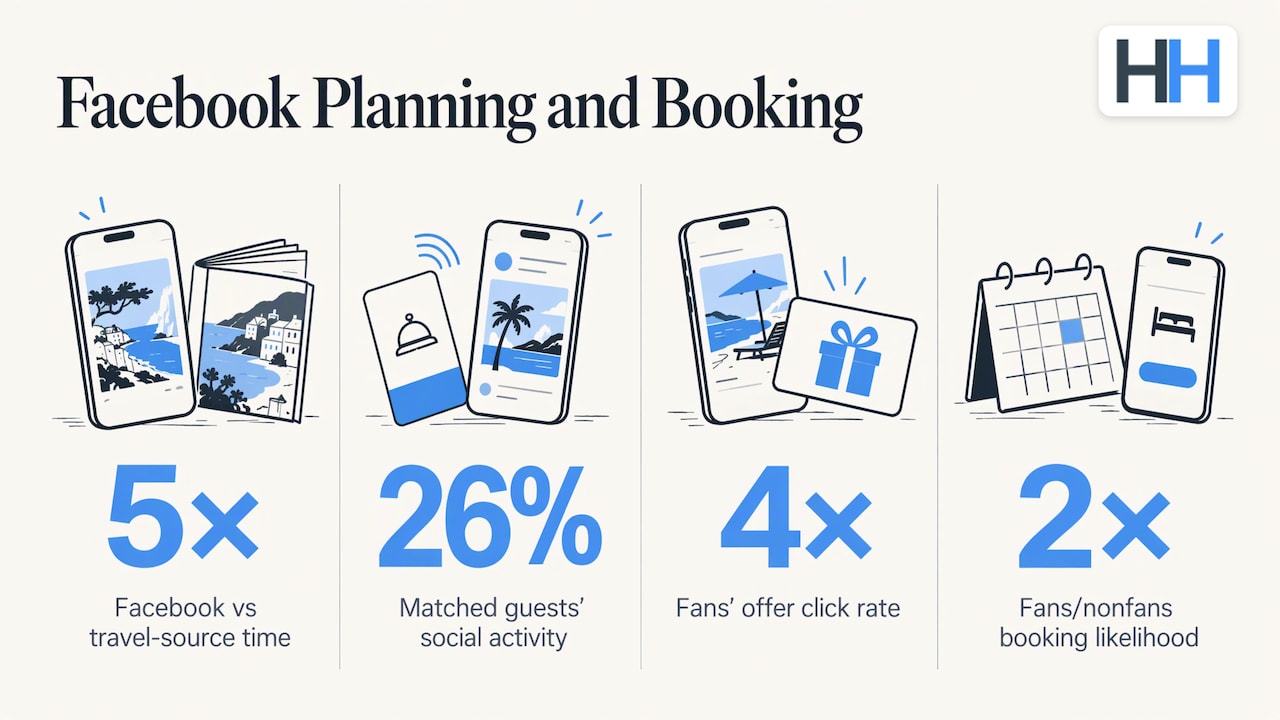
Many owners think Facebook is old news. The data says travelers still use it to plan. The same HSMAI playbook says travelers spend five times more time on Facebook during planning than on travel apps, sites and searches combined. Hotels are not the only ones who see it: the people who share trip photos and ask friends for advice are your future guests.
For an independent hotel, this matters for one reason. An OTA shows your room next to dozens of others and keeps a commission on every sale. Facebook lets you tell your own story, in your own words, to people in your region and to those planning a visit. When the guest then books on your site, you keep the full rate.
Research backs the link between social and booking. A 2015 study at a 640-room Miami hotel found that 26% of matched guests had interacted with the hotel on social media before, during or after their stay. In a Facebook ad test there, fans clicked the offer at four times the rate of non-fans. They were also twice as likely to click through and make a reservation.
The lesson: people who follow your page are warmer. Your job is to grow that group and keep it active.
Set Up Your Page So It Can Sell
Before you post or pay for ads, fix the basics. A guest who lands on your page should see in five seconds who you are, where you are and how to book.
- Use a clear profile photo and cover image. Show your building or your best room, not a stock photo.
- Fill in every detail. Address, phone, hours, amenities and a link to your own booking page.
- Add a booking button. Point it to your direct site, never to an OTA listing.
- Pin one strong post. A weekend package or a direct-booking perk works well.
- Match your name and details everywhere. Your Facebook page, Google Business Profile and website should show the same address and phone number.
That last point links to a bigger problem. When your details differ across the web, guests lose trust and search tools get confused. We cover that in our online presence repair work, which includes Google Business Profile optimization and OTA listing management.
Your booking page matters just as much as your Facebook page. If it is slow or hard to use on a phone, the click from Facebook is wasted. The playbook notes that 60% of hotel guests book on mobile because it is convenient, so the path from post to payment has to feel smooth. Our guide on turning website visitors into bookings shows what to fix first.
What to Post on Your Hotel Facebook Page
The best hotel posts show what it feels like to stay with you and to be in your town. A guest cannot get that from an OTA grid of thumbnails.
Content that earns attention
- Short videos. A 15-second room walkthrough, a coffee being poured, the view from a balcony.
- Local events. Farmers markets, concerts, college weekends, festivals. Tell people they can stay close by.
- Your team. A front desk host, the cook, the person who restores old furniture. People book people.
- Guest moments. Share a happy guest photo or a kind review, with permission.
- Offers. A two-night package or a direct-booking perk, with a clear link.
Facebook stories are useful too. Cvent’s guide lists posts, promos, stories, events and reviews as the five features that matter most for hotels, and notes that adult attention lasts only 8 to 12 seconds. That is why short, quick content works.
How long and how often
There is no magic number, but one academic study gives a useful starting point. Researchers analyzed 60 Facebook campaigns for a franchised hotel in 2018. They found friendly greeting posts did better than event and promotion posts. Their benchmark post had about 50 words, one picture and six colors. Treat that as a guide to keep posts short and clear, not as a rule for every hotel.
A simple, doable rhythm for a small hotel:
| Day | Post type | Example |
|---|---|---|
| Monday | Local event | “This weekend: the harvest fair is 5 minutes away.” |
| Wednesday | Short video | Room tour or a morning at the property |
| Friday | Offer | Weekend package with a direct booking link |
Three good posts a week beat seven rushed ones. If you cannot keep that pace, that is where outside help pays off. Our social media management service delivers curated posts built around local events and travelers, so the page stays active without adding work for your staff. For a wider plan, read our hotel social media marketing strategy.
Build Engagement the Way Guests Expect
Likes are nice, but engagement that leads to bookings looks like conversations. A study from the University of Nevada, Las Vegas, found that people join hotel Facebook pages mostly for social reasons. They want to connect and feel part of something, and a pushy message does not do that. Read the full dissertation for the details.
Put that into practice:
- Reply fast and by name. Answer questions about parking, pets and check-in times in plain words.
- Answer every review. Cvent’s guide suggests replying to at least 40% of guest feedback and always answering negative reviews. Your goal can be higher.
- Share great reviews. A guest’s own words beat your sales copy.
- Ask happy guests to post. Invite in-house guests to leave a Facebook review during their stay.
- Run a small giveaway. For example, a free night in return for a page like and a share. Keep the prize tied to your hotel, so the entrants are real travelers.
Guest photos and stories also give you content you did not have to produce. Our content marketing service includes user generated content (UGC), which turns guest content into posts that feel real. Reading what guests really say about extended-stay living shows how much guest feedback can tell you about what to feature.
Facebook Ads: Reach New Travelers, Then Bring Back Visitors
Organic posts reach a small share of your followers. Ads reach people who have never heard of you. A good hotel plan uses two kinds.
Step 1: Reach people planning a trip
The HSMAI playbook suggests awareness campaigns that use video views, brand awareness or reach goals. It also points to Trip Consideration targeting, which shows your ad to people who seem to be planning travel. HSMAI Americas says this is a simple toggle in Ads Manager that takes about 10 to 20 minutes to set up. It works best with vertical 4:5 videos under 15 seconds and 4:5 images, and the number to watch is site visits.
A real example: a Greek hotel in a 2015 case study paid to boost a quiz post. The paid reach was 9,941, about three times its organic reach of 2,934. Over a year, its page likes grew from 240 to 1,810. A small budget can move the needle when the content is fun.
Step 2: Retarget website visitors
Most people do not book on their first visit. Retargeting shows your ad again to people who looked at your site. The playbook recommends reaching visitors from the past 30 days, leaving out people who already booked, and optimizing for purchases or return on ad spend.
Results can be strong. The playbook reports that the Stewart Hotel in New York City saw a 4.2X increase in revenue when it used Facebook hotel ads versus not using them. It also saw a 5X drop in cost per transaction. These are results from one hotel, so treat them as proof of what is possible and not as a promise.
A simple starter budget plan
- Pick one offer, such as a two-night weekend package.
- Make two short videos and two images.
- Run an awareness ad to travelers within a drive of your hotel.
- Run a retargeting ad to website visitors from the past 30 days.
- Send every click to one booking page that loads fast on a phone.
A discount code made for Facebook, such as a 10% direct-booking code, also helps you see which bookings came from your ads. Our post on hotel booking promotions shows offers that bring direct reservations.
Measure What Matters
Facebook shows plenty of numbers. Only a few connect to money.
- Site visits from your ads, for awareness campaigns.
- Direct bookings and revenue from Facebook traffic.
- Cost per booking, compared to the OTA commission you would have paid.
- Return on ad spend, which is revenue divided by ad cost.
To count bookings, you need Facebook’s tracking tool, called the pixel, installed on your booking pages. A guide to the Facebook Pixel for bookings explains how tracking shows which ads fill your rooms.
Give campaigns enough time. The HSMAI playbook says the measurement window should cover the whole booking period, from first interest to purchase, ideally one to two months for hotels. It also cites a 2019 Boston Consulting Group survey of 100 U.S. senior marketing executives, which found lift measurement can improve spend efficiency by 20 to 40%.
Measurement is a known hard spot. In the Miami study, executives called social media commercially important but said measuring its effect was hard. The same research found that guests who engaged before booking gave hotels a chance to sell room, spa and restaurant packages. So track bookings, and also watch for add-on sales from the same guests.
Facebook and AI Search: Where They Meet
More travelers now ask AI tools questions like “best quiet hotel near the lake.” Those tools pull from many places on the web. Your Facebook page is one of them, along with your website, your Google Business Profile and your reviews.
We cannot promise that a post will make an AI tool name your hotel. What you can do is make sure the facts about your hotel are clear, current and the same everywhere: name, address, amenities, pet policy, nearby attractions and recent guest reviews. Facebook posts that mention local events and real guest stories add fresh, specific detail about your hotel to the web.
That is the idea behind generative engine optimization (GEO) and AI engine optimization (AEO), which means shaping your online content so AI tools can understand and recommend your hotel. Our AI visibility service focuses on this for hotels.
Our Perspective
Most independent hotels do not fail at Facebook because they lack ideas. They fail because nobody has time. A page goes quiet for six weeks, then a rushed post goes up, and guests see a hotel that looks closed.
We think Facebook should be one part of a direct booking system, not a stand-alone chore. The page builds an audience. The website turns that audience into reservations. A clean Google Business Profile and fair, answered reviews make sure that when a guest checks you out, everything agrees.
That is why we pair curated social media posts about local events and travelers with an AI-visible website, and why our approach is built for independent hotels that want fewer OTA commissions. We also offer a 30-day deployment guarantee, so a hotel is not left waiting months to see its system live.
Our advice: keep the posts simple, keep them local, and send every click to a booking page you own.
Chirag
Put a Direct Booking System Behind Your Facebook Page
Facebook builds the audience. A direct booking system turns it into revenue. HotelHero’s Direct Booking System combines targeted social media management to build your guest audience and booking funnels, a remote sales team for group bookings, and online presence repair, all aimed at reducing OTA dependency and growing commission-free bookings. If you want the posts and the funnel handled together, start there. For a full roadmap, see our direct booking strategy for independents.
Your First 30 Days on Facebook
- Week 1: Fix your page details and add a booking button to your own site. Check your Google Business Profile for matching info.
- Week 2: Post three times. Reply to every comment and review.
- Week 3: Add one short video and one local event post. Ask three recent guests for a review.
- Week 4: Install your tracking pixel, launch one awareness ad and one retargeting ad, and note how many visits become bookings.
After 30 days, keep what works and drop what does not. Read our independent hotel marketing playbook for what to add next.
FAQ
Is Facebook marketing worth it for a small independent hotel?
Yes, when it is tied to a direct booking page. Research shows many travelers use Facebook for planning, and fans of a hotel page clicked and booked at higher rates in a Miami ad test. A small hotel can win with local, personal content that OTAs cannot copy.
How often should a hotel post on Facebook?
Three quality posts a week is a good, steady pace for most small hotels. Mix a local event, a short video and an offer. Consistency matters more than volume, so pick a rhythm you can keep all year.
How do I get more engagement on my hotel Facebook page?
Reply quickly to comments, messages and reviews, and share guest photos and kind reviews. Invite in-house guests to review your hotel on Facebook. A small giveaway tied to your hotel can also draw in real local and regional travelers.
Which Facebook ads work best for hotels?
A two-step plan works well. First, run short video or image ads aimed at people planning travel. Then retarget website visitors from the past 30 days, leaving out recent bookers. Send both to one fast, mobile-friendly booking page.
How do I know if my Facebook marketing is working?
Track direct bookings, revenue and cost per booking from Facebook traffic, not just likes. Install the Facebook pixel on your booking pages and give campaigns one to two months to cover the full booking window.
Sources
- Facebook Hotel Playbook (HSMAI, 2020)
- Social Media Marketing in the Hospitality Industry (Healy and Wilson, 2015)
- Facebook marketing campaign benchmarking for a franchised hotel (2018)
- Facebook Marketing for Hotels: The Complete Guide (Cvent, 2026)
- The Marketing Effectiveness of Hotel Facebook Pages (UNLV, 2012)
- Effectively Market Hotels on Facebook (HSMAI Americas)
- Social Media ROI and Performance Evaluation in the Hotel Industry (2015)