· 10 min read
Group Booking Lead Generation for Independent Hotels
Learn how independent hotels find group booking leads, qualify them, and follow up fast so more groups book direct and OTA commissions shrink.
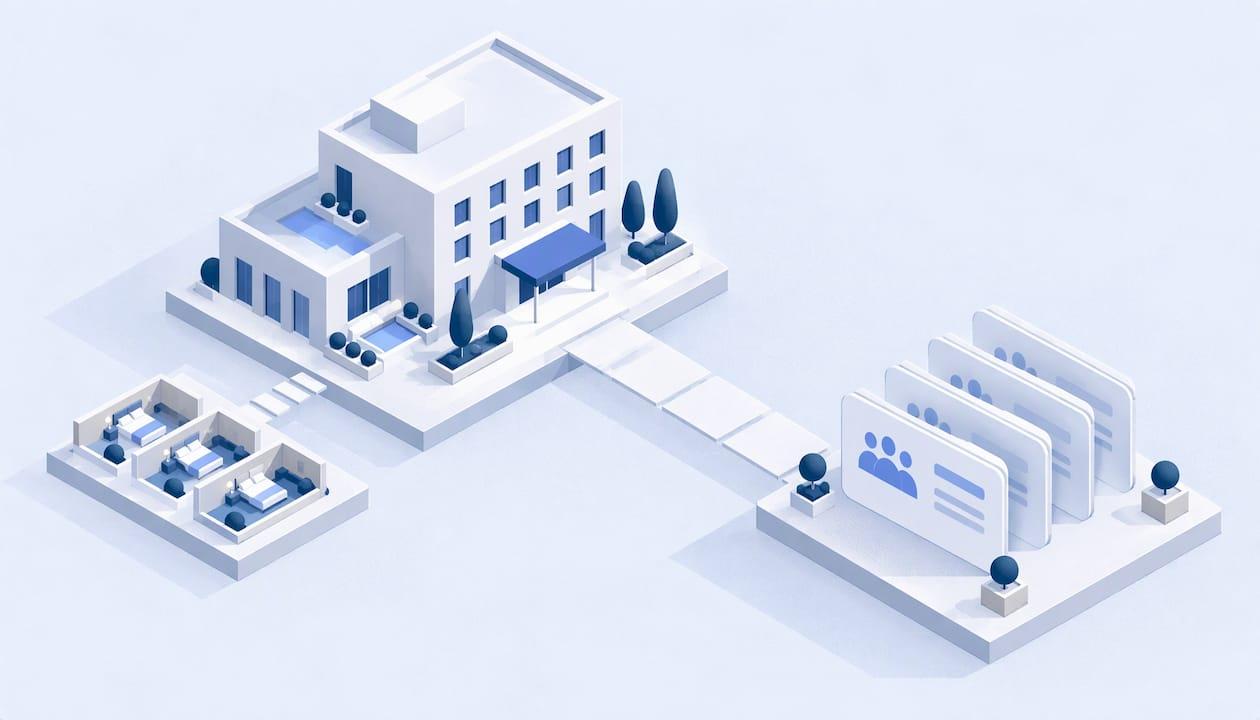
Group booking lead generation is the work of finding teams, events, and planners who need many rooms, and getting them to ask your hotel for a quote. For an independent hotel, the winning plan has three parts: be easy to find, reach out to groups before they find a rival, and answer every request fast. HotelHero builds this for independent hotels through a direct booking system with a remote sales team for group bookings. Below is the full routine, so you can see each step and where it breaks.
Free with every demo
Get a website guests and AI both recommend.
- See your new AI-visible website on the call
- Social content made and posted for you
- The website is yours to keep, free
Key Takeaways
- A group lead is a real buyer only when you know the dates, the room count, and who signs the contract.
- Most groups are small, so independent hotels can win them. Planners often want 50 people or fewer.
- Speed and follow-up win deals. A fast first reply and several touches beat a single email.
- Your website, Google profile, and AI search visibility decide whether planners even see your hotel.
- Outbound outreach to groups, such as work crews, fills slow weeks without paying OTA commissions.
What counts as a group booking lead?
A group is not just “a few rooms.” Hotels set their own line. One large hotel company defines a group as a contracted booking of at least 10 guest rooms on the peak night. Another major brand’s reservation glossary says a group is business where rooms are set aside from general inventory under agreed terms. That set-aside block is the key idea: you hold rooms for the group, and the group agrees to rules about payment and cancellation.
Small hotels can set a lower line. A 40-room inn may treat 5 rooms as a group. A big convention hotel may want 30. Pick the number that fits your own room count and write it down, so your team treats every request the same way.
The three stages of a lead
Hotels sort group leads by how close they are to a signed deal. The labels below come from the same large hotel company’s policy:
| Stage | What it means |
|---|---|
| Prospect | You have talked to the planner. They show interest. You know rough dates and room counts. No contract sent. |
| Tentative | A contract has been sent but not signed. |
| Definite | Both sides have signed. |
This matters because a list full of “prospects” is not a pipeline. Count each stage on its own, and you will see where deals stall.
Where group leads come from
Group demand is not only huge conventions. Data from a hotel software company showed that 63% of event requests for proposals (RFPs) were for groups of 50 people or less. An RFP is a document where a planner asks hotels for a price on a block of rooms. The same report found planners now book closer to the event: the average lead time dropped from 223 days in 2019 to 193 days in 2021.
That is good news for an independent hotel. Small and mid-size groups fit a 30 to 100 room property well. Common sources include:
- Corporate teams: training days, sales meetings, retreats.
- Weddings and family events: a 100-guest wedding often needs only 40 to 60 rooms, because guests share rooms or live nearby.
- Sports teams and clubs: tournaments and travel teams.
- Work crews: construction and utility crews who need rooms for weeks at a time.
- Reunions, tours, and associations.
There are three ways these groups reach you. Some find your website or Google profile. Some send requests through booking networks and RFP sites. And some you reach first, through outreach. A healthy plan uses all three, because relying on one source leaves you weak when it slows down.
Be easy to find: your website and search visibility
Planners compare many hotels. One hotel executive told Today’s Hotelier that planners look at dozens of sites, and that hotels that tell their story well tend to win more often. The same article says outside lead networks still matter, but a hotel also needs its own strong digital presence.
For group business, your site should answer the planner’s questions before they ask:
- Room count and layout. How many rooms, how many on one floor, which are connected.
- Meeting and event space. Sizes, setups, and photos.
- Group perks. Free breakfast, parking for vans or trucks, a shuttle, extended-stay rates.
- A simple request form. Ask only for dates, room count, budget, and contact. Long forms lose leads.
- Local appeal. Events, venues, and employers nearby that bring groups to town.
Then there is the new part: planners now ask AI tools where to stay. If your hotel is not described clearly online, those tools have little to recommend. Our guides on how guests find your hotel with AI and how independent hotels get recommended by AI explain this in plain terms. HotelHero offers Generative Engine Optimization and AI Engine Optimization for exactly this job.
Your Google Business Profile is the other big piece. Correct hours, photos, a working phone number, and fresh reviews help a planner trust you in seconds. HotelHero’s online presence repair covers Google Business Profile optimization, OTA listings management, and reputation review services.
Use content tied to local events
Posts about nearby festivals, game days, trade shows, and company news give planners a reason to think of you. They also show you know the area. HotelHero’s social media and content marketing creates posts around local events and travelers, so a hotel without a marketing team can still stay visible.
If you want a wider view of direct booking tactics, this direct booking strategy guide covers ideas you can adapt for your own property.
Reach out first: outbound group sales
Waiting for requests leaves money on the table. The same Today’s Hotelier piece advises hotels to market to meeting planners with the same intensity used for transient guests, especially in soft periods.
Outbound work means you make a list of groups likely to need rooms, find the right person, and contact them. Hotel companies are using more technology for this. One report says AI helps sales leaders research companies and find decision makers, which makes them more proactive.

But tools do not replace people. A hotel sales leader told HSMAI that event-data tools give intelligence that hotels did not have before, yet she also said selling is still about relationships.
Here is where small hotels get stuck. The owner or front desk lead is already busy. Outreach gets done in a burst, then dropped for weeks. That is why HotelHero offers a remote sales team for group bookings: it works on group outreach so the job does not depend on a busy owner. For work crews in particular, see our construction crew prospecting service.
Slow weeks and steady crews
Groups fill the gaps that single travelers leave. A crew that books 8 rooms for 6 weeks gives you steady occupancy on weeknights, when leisure demand is low. That is the kind of business an outreach plan can target on purpose, and it comes without the commission an OTA would take.
Qualify before you quote
Not every request deserves a custom proposal. Marketing teams that study this say group leads are usually scored on event size, dates, budget, space needs, how complete the RFP is, the planner’s history, and corporate travel volume. You do not need software for this. A simple checklist works:
| Question | Why it matters |
|---|---|
| Do the dates fit your slow or busy periods? | Groups on busy nights may displace higher-paying guests. Groups on slow nights are gold. |
| How many rooms per night? | Sets your block size and rate. |
| Who makes the final decision? | Avoids weeks of talking to someone who cannot sign. |
| What is the budget? | Tells you if you can meet it before you spend time. |
| Has this planner booked before? | Repeat planners close faster. |
| Do they need meeting space or food? | Adds revenue beyond rooms. |
Give each answer a score of 1 to 3 and add them up. Call the top leads first. Even a rough score beats treating every request the same.
Follow up fast, and keep following up
This is where most hotels lose the deal. One sales expert says what works now is speed, specificity, and follow-through: reply in minutes, not days, build the proposal around what the planner cares about, and keep in touch until they decide.
The numbers show how many hotels miss this. A hotel trainer writing in Hotel Online says most salespeople do not follow up more than once after the first reply. He suggests changing the format: a voicemail, then an email, then a short personal video.
A simple follow-up routine:
- Within the hour: a short reply with a direct answer and one question about their dates.
- Same day: a proposal draft or a call to talk through it.
- Day 3: a short check-in with one new fact, such as a photo of the meeting room.
- Day 7: a call or voicemail.
- Day 14: a final note that asks if the plans changed, and leaves the door open.
Assign one person to each lead. Without a clear owner, replies slip through.
Keep your system tidy
Once a contract is sent, record it right away. One hotel company’s policy asks teams to enter a Tentative booking in its systems within 24 hours of sending the contract. It also sets a standard cut-off date of 21 days before arrival, after which the group must confirm its final rooms. You can copy the idea at your size: pick a cut-off, put it in the contract, and track it.
Measure what matters
To know if your group plan works, track a few numbers every month:
- Leads by source: website, outreach, networks, referrals.
- Response time: how long until the first reply.
- Stage counts: how many Prospect, Tentative, and Definite groups you have.
- Close rate: Definite groups divided by qualified leads.
- Room nights booked direct: the number that shows less reliance on OTAs.
- Revenue per group: rooms plus meeting space and food.
A hotel group’s trainer note: if you do not measure, you will not know where money slips away. Review the list once a month and change one thing at a time.
Our view: why group leads need a system, not a burst of effort
We built HotelHero for independent hotels that want more direct bookings and do not have a big marketing team. Group business is a good example of why.
Group leads come from three places: people who find you, people you reach first, and people who return. Most hotels do only the first. They wait for a form to arrive. We think the best results come when all three run together.
That is why our direct booking system joins an AI-visible website, social media that builds a guest audience, a remote sales team for group bookings, and online presence repair. Each part feeds the others. A planner who sees a post about a local event, checks your Google profile, and then gets a call from a sales rep has met your hotel three times. That builds trust.
Our goal is commission-free bookings. Every group that books direct is a group that does not pay an OTA fee. We also offer a 30-day deployment guarantee, so you are not waiting months to start.
We also see work crews as a strong fit for independent hotels, which is why we offer construction crew prospecting.
Chirag
How HotelHero can help
If you want group leads without hiring a full sales team, start with our Direct Booking System. It combines a remote sales team for group bookings, social media management that builds your guest audience, and online presence repair. We focus on independent hotels and on commission-free direct bookings. Pick a service page that matches your biggest gap, or contact us to talk through where your group business stands. For more on filling rooms, read our simple guide to hotel lead generation and our post on turning calls into bookings.
FAQ
How many rooms make a group booking?
Most hotels use 10 rooms per night under one contract as the line. Smaller hotels may use as few as 5, and large hotels may use 30. Set a number that fits your property and use it every time.
How do I get group booking leads for my hotel?
Use three paths at once. Make your website, Google profile, and AI search presence clear so planners find you. Reach out to groups such as teams, clubs, and work crews. Reply fast to every request and follow up several times.
What is the difference between a Prospect, Tentative, and Definite group?
A Prospect has shown interest and shared rough dates and room counts, but has no contract yet. A Tentative group has been sent a contract that is not signed. A Definite group has signed, so the rooms are booked.
How fast should I reply to a group request?
Aim for minutes, not days. Industry sales leaders say speed, a proposal built around the planner’s needs, and steady follow-up are what win business now. Even a short first reply that asks about dates keeps you in the running.
Sources
- Group booking policies (hotel company policy, 2021)
- Group definitions in a hotel reservation system glossary
- Group Travel Is Different: Here’s Why, Amadeus Hospitality
- Hotel RFP template and group room guidance
- By the Masses, Today’s Hotelier (February 2026)
- Hotels get more strategic in pursuit of group business, Hotel Management
- Finding the Right Group Business, HSMAI (2019)
- How hotels score group vs. individual booking leads
- 7 Important Things Hotel Salespeople Should Do With Every Inbound Lead, Hotel Online
- Direct booking strategy guide